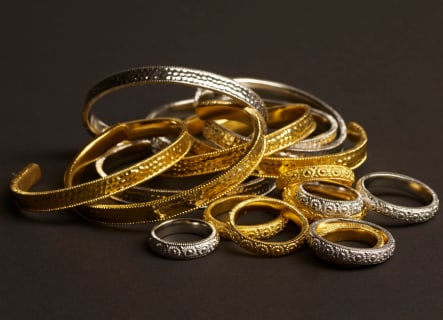
The Menē philosophy: pure precious metal in gold, platinum, and silver.
explore
For anyone who has worn a piece of jewelry that left a red mark on the skin, a green tint on the finger, or an itch that lasted long after the piece was removed, the question is familiar. Why does some jewelry react with the skin and other jewelry does not?
The answer rarely has to do with the wearer. It has to do with what the piece is made of. Pure precious metals, specifically 24k gold and pure platinum, are among the few materials that the skin reliably tolerates without reaction. They have been worn against the body across civilizations for years for many reasons, and one of them is this: pure precious metal does not provoke the skin.

Most jewelry on the market is not made from a single metal. Lower-karat gold, white gold, and many silver pieces are alloys, meaning the precious metal is mixed with other materials to give the piece additional strength, color, or workability. Plated jewelry takes this further, with a base metal core covered by a thin layer of gold or another finish.
The metals added to these alloys are often the source of skin reactions. Nickel is the most common culprit and one of the most frequent causes of contact dermatitis worldwide, but copper, brass, zinc, and other base metals can also provoke responses ranging from mild irritation to persistent rashes. When these metals come into contact with sweat, moisture, or natural skin oils, small amounts of metal ions can be released, which the skin can read as foreign and respond to.
Plated jewelry presents an additional risk. Even when the surface layer is gold, that layer wears down over time. As it does, the base metal beneath is exposed to the skin, often without the wearer realizing that the piece is no longer truly gold against their body.
This is part of why many people experience reactions to jewelry they did not previously have problems with, particularly to pieces that are not made from pure precious metal.
Pure precious metals behave differently from alloys at the level of chemistry. The reactions that cause irritation depend on the metal interacting with the skin, releasing ions, or oxidizing in response to moisture. Pure gold and pure platinum are exceptionally stable. They do not corrode, oxidize, or react with the substances they encounter on the body, which means they do not release the ions that trigger the immune response in sensitive skin.
24k gold, at approximately 99.9 percent purity, contains almost no other materials. There is no nickel, no copper, no zinc, and no plated surface to wear away. The same is true of pure platinum at PT999, which contains 99.9 percent platinum. The metal that touches the skin is the metal itself, in its complete form, with nothing else to provoke a reaction.
This is what makes 24k gold and pure platinum hypoallergenic by nature. They are not treated to become safe for sensitive skin. They are safe because of what they are.
The most common metal allergy is nickel. Nickel allergy can develop at any age and tends to be cumulative, meaning that even people who wore nickel-containing jewelry comfortably for years can suddenly develop sensitivity.
Other common metal allergies include reactions to chromium, cobalt, and copper, each of which can be present in jewelry alloys and plated pieces. The reactions can range from mild redness to longer-lasting sensitivity, and in most cases resolve once the metal is removed from contact with the skin.
For wearers with diagnosed metal allergies, the most reliable solution is to wear only pure precious metal. Pieces in 24k gold, pure platinum, and pure silver carry no risk of triggering a nickel or copper reaction, since these materials are not present in the piece.
For wearers without diagnosed allergies who experience occasional irritation from jewelry, the same principle applies. The pieces that react most rarely with the skin are the ones made from the metal itself, without alloy or plating.
A piece of jewelry intended to be worn every day deserves to be made from a material that can be worn against the skin without issue. This is part of why 24k gold and pure platinum have been chosen across cultures for the pieces meant to be worn continuously, including wedding bands, daily chains, and inherited pieces that move through generations of wearers.
For pieces worn close to the skin, against moisture, through changes in temperature and through the natural oils of the body, the material matters more than the design. A piece in pure precious metal can be worn against the skin day after day without provoking the body or losing its character. A piece in plated metal or low-purity alloy will eventually wear, oxidize, or change in some way that the wearer feels.
For sensitive skin, this is the difference between a piece that becomes part of daily life and a piece that has to be put away.
Every Menē piece is crafted in 24k gold or pure platinum, the two precious metals most suited to wear against sensitive skin. Each piece contains no plating, no alloy, and no surface treatment, which means the metal in contact with the skin is the metal itself.
For wearers with metal allergies, sensitive skin, or simply a preference for pieces that can be worn continuously, the Menē collection offers a range of pieces shaped from precious metals in their purest form.

Yes. 24k gold is one of the most hypoallergenic metals used in jewelry. At approximately 99.9 percent purity, it contains almost no other materials, which means there is no nickel, copper, or other alloy to react with the skin. Pure gold is exceptionally stable and does not release the ions that trigger allergic responses.
Pure platinum is widely considered the most hypoallergenic precious metal, with 24k gold a close second. Both are stable, do not corrode, and contain no alloy materials that commonly trigger skin reactions. Either is suitable for wearers with sensitive skin or known metal allergies.
Most gold jewelry irritates the skin because it is not pure gold. Lower-karat gold contains other metals such as nickel or copper, which can react with sweat and skin oils to release ions that trigger contact dermatitis. Plated jewelry also reacts as the surface layer wears away, exposing the base metal beneath.
Both pure platinum and 24k gold are excellent choices for sensitive skin, with very low rates of allergic reaction. Pure platinum may be marginally preferred for those with diagnosed metal allergies due to its even greater chemical stability, but both metals are hypoallergenic by nature.
Yes. 24k gold and pure platinum can be worn continuously without irritating the skin. They do not tarnish, corrode, or release ions through normal wear, which makes them well suited to pieces worn through daily activity.