The Menē philosophy: pure precious metal in gold, platinum, and silver.
explore
The most enduring forms of inheritance are rarely the ones that come with a deed or a signature. They arrive instead as objects, handed from one person to another at moments of transition, carrying the weight of who held them before. Among these, gold jewelry has held its place across centuries as the form of inheritance that travels most easily between hands.
A piece of pure gold is at once an object of beauty and a recognized form of value. It can be worn, kept, or held, and its meaning moves with it across every generation that receives it.

Long before banks, deeds, or formal financial systems, gold served as a recognized form of value that could move with a family across borders, generations, and circumstances. In nearly every civilization where it has been used, gold has been the form of inheritance that did not require an institution to hold it. A piece of gold could be carried, worn, hidden, or given away, and its meaning remained intact through every change in hands.
That is part of why gold has been so consistently chosen for inheritance. Currencies have come and gone. Empires have risen and fallen. Through all of it, gold has remained recognized across the world. A piece of pure gold given to a daughter or a grandson does not depend on the survival of the institution that produced it. The piece is held in the metal itself.
This is the foundational reason gold has functioned as both heirloom and recognized form of value. The two roles are not separate. The same piece of jewelry that carries personal meaning across generations also carries material continuity that allows it to travel forward intact.
Not all materials pass cleanly between generations. Most lose their form, their finish, or their meaning over time. Three qualities make pure gold particularly suited to inheritance.
The first is permanence. Pure gold does not tarnish, oxidize, or corrode. A piece of 24k gold worn fifty years ago can be worn today with its color and form intact, which is rarely true of any other material used in jewelry. The piece itself survives, which means the inheritance survives with it.
The second is portability. A gold piece is small and light, and carries its full character within itself. A single ring or chain can hold significant meaning while moving easily between hands, across cities, and through time.
The third is recognition. Gold is one of the few materials whose qualities are understood in nearly every part of the world. The same piece of 24k gold reads as pure gold in any market, in any era. That universality is part of what allows it to function as an heirloom.
Pieces made from 24k gold carry their full material content in the metal itself, without plating, surface treatment, or alloy. The piece can be worn, reshaped, or kept across generations with the underlying metal intact. Lower-karat alloys and plated jewelry lose their finish over time, with little of the original material to carry forward.
Pure gold also allows for evolution within a family. Pieces can be reshaped or recast across generations as tastes change or as new wearers receive them, with the same gold carrying forward in a new form. The metal itself remains, even as the piece around it takes new shape.
The role of gold as inheritance is most explicit in cultures where the practice has been formalized over centuries.
In South Asian traditions, the giving of gold to a bride at her wedding is one of the oldest continuous practices of family inheritance in the world. The tradition of streedhan, the bride's own gold held in jewelry, dates back thousands of years and persists today. The pieces are given by the bride's family and the groom's family, kept by the bride as her own, and often passed to her daughter at her own wedding. The gold itself moves through the family, carrying both personal meaning and material continuity across generations.
In Chinese tradition, gold jewelry is similarly central to wedding gifting, with the giving of pure gold by the groom's family establishing a lasting connection between families and a tangible piece kept within the family across generations. In Middle Eastern and North African cultures, the mahr, or bridal gift, has long included gold among the pieces transferred at marriage, and the tradition of keeping gold within the family across generations remains strong.
European traditions of inheritance have shifted across the centuries but have often centered on jewelry as one of the most personal forms of bequest. Rings, brooches, and chains have moved between mothers and daughters, fathers and sons, often with stories attached that travel alongside the metal.
Across each of these traditions, pure gold has held a consistent role. The piece carries the meaning of the gesture and the character of the metal, both held in the same form across generations.
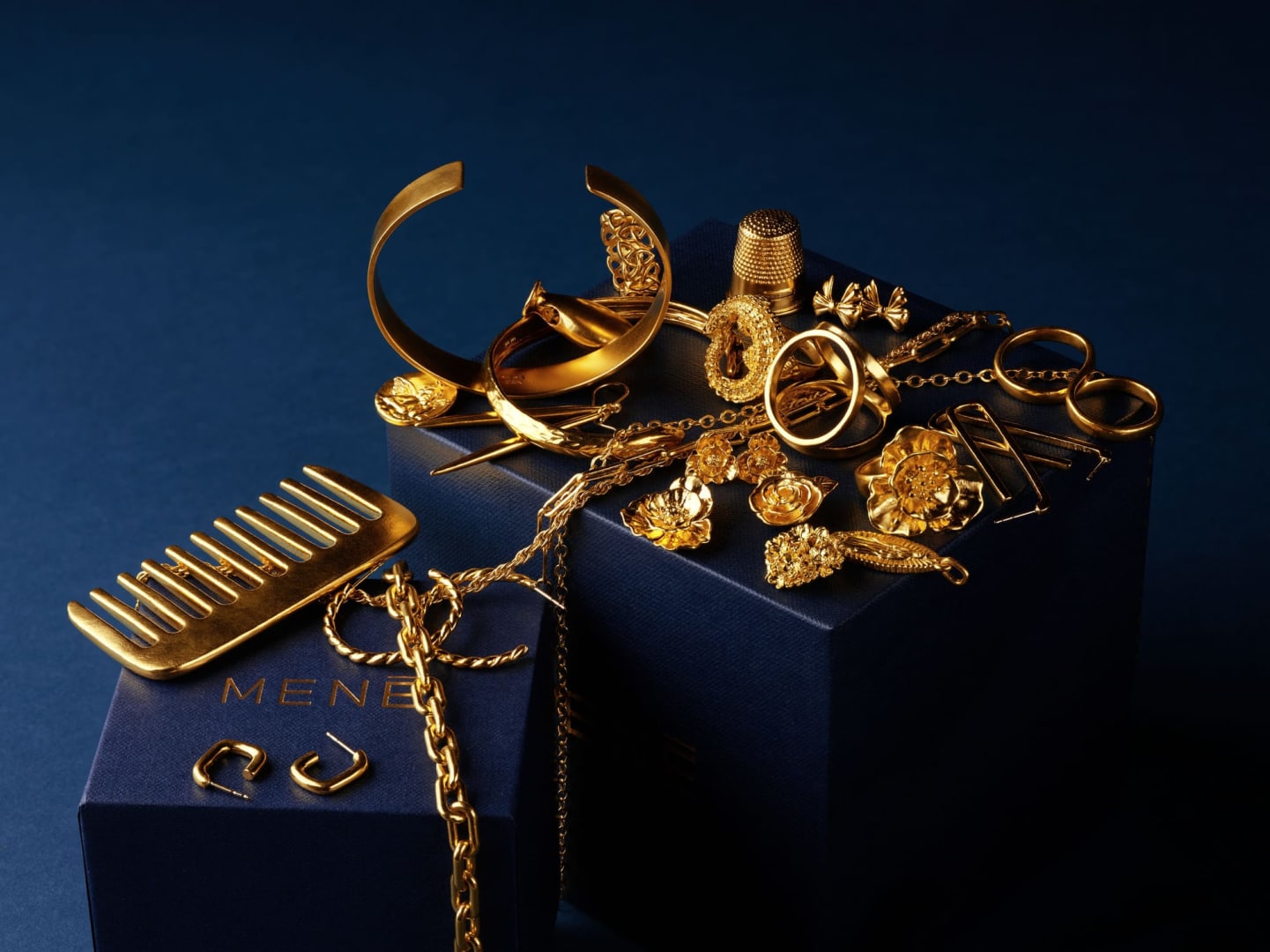
Every Menē piece is crafted in 24k gold or pure platinum, the form of precious metal most suited to inheritance. Each is accompanied by a certificate of appraisal that documents the purity and weight of the piece at the time of acquisition, providing a permanent record that travels with it.
Explore the Menē collection in 24k gold and discover pieces shaped to be worn, kept, and passed on.
Gold has been passed on across generations because it endures. The metal does not tarnish, lose its color, or change form across decades of wear, which means a piece given today can travel intact through every generation that receives it. Its recognized character across cultures has also made it one of the most enduring forms of inheritance.
Jewelry made from pure precious metal, specifically 24k gold or pure platinum, holds up most consistently over time. Lower-karat alloys and plated jewelry lose their finish as surfaces wear, while pure metal retains its character across generations.
Heirlooms are often made of gold because the metal endures in ways few materials do. Pure gold does not tarnish, corrode, or lose its color across decades of wear, which means the piece itself survives intact. Gold is also recognized across nearly every culture and era, which allows it to carry meaning forward through time.
24k gold is the form of gold most suited to pieces intended to be passed on, as it represents the highest level of purity used in jewelry. The piece holds its full material content in the metal itself, without surface treatments or alloys that wear or fade over time.
Yes. Pure gold can be melted and reshaped without losing the underlying material, which is part of why families have historically been able to evolve heirloom pieces across generations while keeping the same gold within the family.