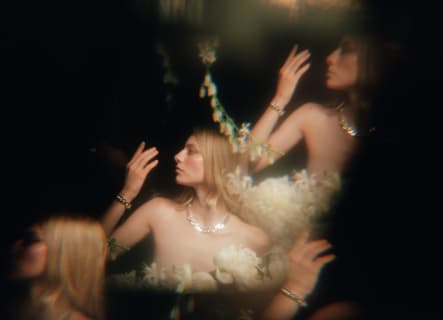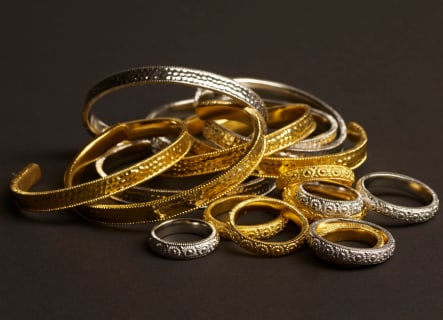
The Menē philosophy: pure precious metal in gold, platinum, and silver.
explore

Bridal jewelry is among the oldest forms of adornment carried continuously across civilizations. For thousands of years, the marking of marriage has been accompanied by pieces of gold, worn on the day, kept long after, and passed across generations. The forms have varied across cultures, but the intention has remained consistent: to honor the union, to confer blessing, and to carry meaning forward in a material that endures.

The earliest forms of bridal jewelry emerged in the cradles of civilization, where the symbolism of marriage and the symbolism of gold were already deeply intertwined. By 3000 BCE, ancient Egyptians were exchanging wedding rings made from braided reeds and later from gold, worn on the fourth finger of the left hand. The placement was believed to follow the vena amoris, the vein of love, thought to run directly to the heart. This idea has endured in many cultures to the present day.
In Mesopotamia, the royal tombs of Ur, dating to around 2600 BCE, contained the earliest complete sets of bridal adornment yet discovered. Brides of the ruling class wore gold headdresses, necklaces, earrings, and bracelets, often set with lapis lazuli. These pieces were not only personal ornaments but ceremonial objects, marking the bride as a person of consequence within the union being formed.
In the Indus Valley, jewelry traditions dating to around 3300 BCE established many of the bridal customs that continue across South Asia today. Toe rings, ankle bracelets, and elaborate gold ornaments were worn by brides to mark the transition into married life, and the practice of giving gold to the bride at her wedding has remained largely unchanged for more than four thousand years.
Each of these civilizations arrived at the same conclusion independently: that the marking of marriage required adornment, and that adornment required gold.
The reasons gold has accompanied marriage across nearly every civilization are tied to qualities inherent in the metal itself. Gold does not tarnish, does not corrode, and does not lose its color with time. Unlike many other materials, it is recognized and valued across cultures, which gives it both a symbolic and a practical role within the wedding tradition.
Symbolically, gold has long been associated with the sun, with prosperity, and with the divine. In ancient Egypt, gold was considered the flesh of the gods, used to adorn the bodies and tombs of pharaohs as a substance believed to confer immortality. In Hindu tradition, gold is sacred to the goddess Lakshmi, the deity of prosperity, abundance, and blessing for the new union, which is why South Asian wedding traditions have long centered on the giving of gold jewelry to the bride. In Chinese tradition, gold has been associated with marital harmony and the doubling of joy.
Practically, gold's permanence allowed it to function as a form of lasting wealth. Bridal jewelry has historically been given to the bride as her own property, carried with her into the marriage and held within the family as a tangible store of value. In many cultures, this practice continues today, with bridal gold passed from mother to daughter as both adornment and inheritance.
This combination of symbolic resonance and material value is part of what has made gold the defining metal of bridal adornment across civilizations.
While gold has been a constant across bridal traditions, the forms it has taken have varied widely. Each culture has shaped its bridal adornment around its own symbols, beliefs, and aesthetic sensibilities.
In South Asian cultures, the bride is traditionally adorned in an extensive suite of gold pieces, including necklaces, earrings, bangles, nose rings, and ornaments worn in the hair. The pieces are often gifted by the bride's family and the groom's family, marking the union of two households as much as two individuals. The tradition of streedhan, the bride's own wealth held in gold jewelry, dates back thousands of years and remains central to South Asian wedding practice today.
In Chinese tradition, gold has long been associated with marital harmony, prosperity, and the doubling of joy. The Double Happiness symbol, formed from two repetitions of the character for joy, is one of the most enduring motifs in Chinese wedding tradition and is often given to the bride as a pendant or charm. The four pieces traditionally given to the bride, known as the si dian jin, include a necklace, earrings, a bracelet, and a ring, all in gold.
European bridal traditions have shifted across the centuries but have remained anchored in the wedding band. Roman brides received iron rings as a sign of contractual commitment, which gave way to gold rings as Christianity spread across the empire. By the medieval period, the gold band had become the central piece of European bridal adornment, accompanied in royal and aristocratic weddings by crowns, brooches, and elaborate gold collars.
In Middle Eastern and North African cultures, the giving of mahr, a bridal gift presented by the groom, has long included gold jewelry alongside other forms of wealth. The specific forms vary across regions, but gold remains the central material, often crafted in distinctive styles ranging from intricate filigree to bold, sculptural pieces meant to be worn together as a coordinated set.
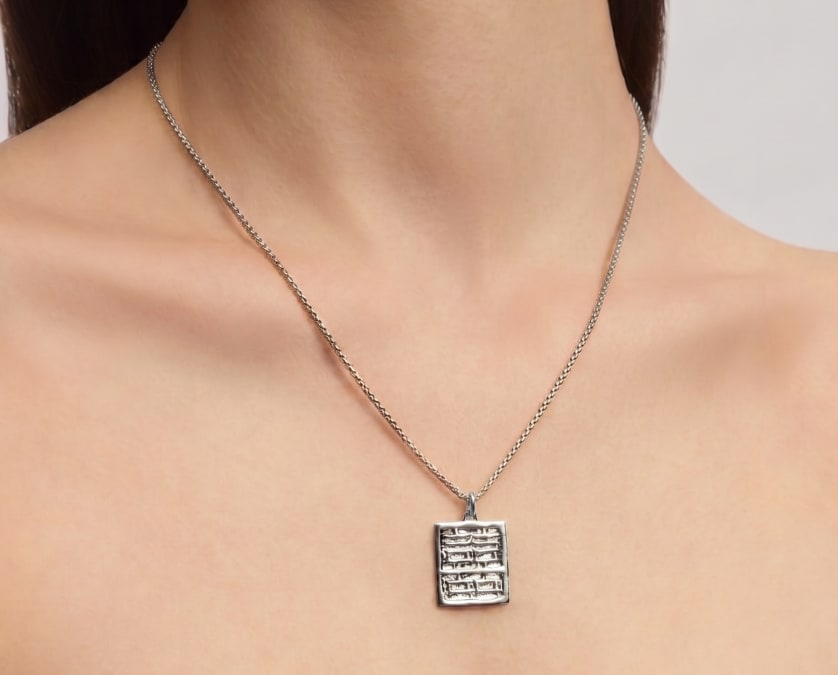
One of the most enduring qualities of bridal jewelry is its function as an heirloom. Pieces given to the bride at her wedding are rarely meant to be worn only on the day. They are intended to be kept, worn across the years of the marriage, and passed to the next generation when the time comes.
This is part of why the material matters. A piece of pure gold worn at a wedding fifty years ago can be worn again today, with its color and form intact. The same is rarely true of pieces made from base metals or surface-treated alloys, which fade, tarnish, or lose their finish over time.
The bridal heirloom is therefore both a personal and a material inheritance. It carries the story of the wedding and the family forward, and the metal it is made from holds its value alongside its meaning.
The bridal traditions of the past continue to shape how jewelry is chosen for weddings today. While the specific forms have evolved, the underlying intention has not: to mark the union in adornment that carries meaning beyond the day itself, in a material chosen for both its symbolism and its endurance.
The Menē Wedding Curation is shaped around this tradition. Every piece is crafted in 24k gold or pure platinum, honoring the role of pure precious metal in bridal adornment across civilizations.
Brides have worn gold for thousands of years because the metal carries both symbolic and material significance. Gold has been associated with prosperity, blessing, and permanence across nearly every culture, and its enduring value has made it a form of lasting wealth carried from one generation to the next.
Bridal jewelry symbolizes the union being formed, the blessing given to the new marriage, and the continuity between families. The specific symbols vary across cultures, from the Double Happiness motif in Chinese tradition to the Goddess Lakshmi imagery in Hindu tradition, but the underlying meaning is shared across civilizations.
Gold is the chosen metal because it endures. It does not tarnish, lose its color, or corrode, which makes it both a fitting symbol of a lasting union and a practical store of value. Its associations with prosperity, blessing, and the divine have also made it preferred across cultures.
Bridal gold refers to the gold jewelry given to or worn by a bride at her wedding. The pieces are often retained by the bride as her own property and held within the family as both adornment and inheritance, passed from mother to daughter across generations.
A bridal heirloom is a piece of jewelry given at or for a wedding that is intended to be kept and passed to the next generation. The defining qualities are durability, symbolic significance, and material value. Pieces made in pure precious metal are best suited to this purpose.