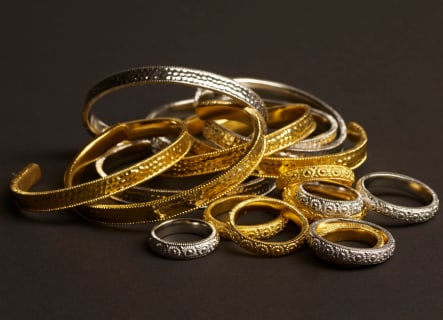
The Menē philosophy: pure precious metal in gold, platinum, and silver.
explore

Few pieces of jewelry are worn with the consistency of a wedding band. It is present every day, across decades, and often beyond a single lifetime.
The material should reflect that intention. Pure precious metals hold their value and their meaning across time, allowing the ring to carry both the permanence of the bond it marks and a personal detail held privately within the metal.

Gold and platinum are the two metals that have endured as the standard for fine jewelry. Other materials are often presented as alternatives, including white gold, tungsten, and brushed or blackened steel, though none of these are precious metals of their own. White gold is a gold alloy finished with a rhodium coating that wears over time, requiring the piece to be re-dipped every one to two years to maintain its appearance, while tungsten and steel are base metals with no intrinsic value. Pure 24k gold and pure platinum require no such treatment, as their color and their value are held in the metal itself.
Gold has been associated with warmth, prosperity, and continuity across nearly every civilization in which it has appeared. In its purest form, 24k gold has a deep yellow color, brighter and more saturated than lower-karat alloys.
Platinum is associated with rarity, endurance, and quiet strength. Its tone is cooler than gold and its density greater, lending the piece a more grounded presence on the hand.
Gold tends to complement warm, golden, or olive undertones. Platinum tends to complement cool or rosy undertones. Trying both metals in natural light is the most reliable way to determine which feels right.
Menē offers wedding bands in sizes 4 through 13, with quarter sizes available upon request.
Wrap a thin strip of paper or string around the base of the finger where the band will sit. The wrap should feel snug but not tight. Mark where it overlaps, lay it flat against a millimeter ruler, and measure the length. Match the result to a standard ring size chart.
A few considerations refine accuracy. Fingers are smaller in the morning and larger by evening, so taking two or three readings across different times of day produces a more reliable result. Wider bands sit more snugly on the finger than narrower ones, so for the Wide profiles, sizing up by a quarter or half size often improves the fit.
If a well-fitting ring is already worn on the same finger, measure the inner diameter directly. Lay the ring flat and measure across the inside opening at its widest point. Match the result to a sizing chart.

Menē wedding bands are offered in four distinct styles, each crafted entirely in 24k gold or pure platinum. The differences between them lie in profile and surface, allowing the choice of style to reflect personal preference alongside the choice of metal.
The Classic Band is the foundational form within the collection. Balanced in its proportions and rounded along its outer surface, it is a piece designed to be worn every day and to feel resolved on its own.
The Flat Band carries a clean, linear profile with a flat outer surface, giving the piece a more architectural presence on the hand. Its precise edges and even surface lend the band a quiet modernity.
The Axis Band introduces a sculptural detail through a raised central line that runs the circumference of the band, drawing a subtle axis of light across the metal. The result is a form that holds greater visual depth while remaining understated.
The Faceted Band is shaped with multiple flat surfaces along its outer profile, catching and reflecting light differently from every angle. The faceted finish gives the piece a more dynamic presence, particularly visible in 24k gold where the depth of color amplifies each plane.
The Classic, Flat, and Axis bands can be engraved on the interior surface upon request, with initials, a date, or a brief inscription held within the metal. Engraving adds a private detail to the band, allowing the piece to carry a personal note that reflects the moment it marks.
Each style is offered in a Narrow and Wide profile alongside its standard width. The Narrow bands sit closer to the finger with a finer profile, suited to a more understated piece or to layering alongside an engagement ring. The Wide styles are more substantial, giving the band greater presence on the hand.
Discover the full collection of Menē wedding bands in 24k gold and pure platinum.
Neither metal is objectively better. 24k gold offers warmth and a deep yellow color tied to its long association with prosperity and continuity. Pure platinum offers a cooler tone, greater density, and a reputation for endurance. Both hold their character through the metal itself rather than through any applied surface, which is why they have endured as the standard for fine jewelry across centuries.
White gold is a gold alloy finished with a rhodium coating to achieve its bright white finish. As the rhodium wears, the warmer underlying alloy is revealed, which is why white gold pieces gradually take on a yellow or grey cast and require re-dipping every one to two years to maintain their original appearance.
Wrap a thin strip of paper or string around the base of the finger where the band will sit. Mark where it overlaps, lay it flat against a millimeter ruler, and measure the length. Match the result to a standard ring size chart. Measure in the late afternoon, when the finger is at its most consistent size.
24k gold is softer than lower-karat alloys due to its purity, which is one of the qualities that makes it the most valuable form of gold used in jewelry. With proper care, a 24k gold ring retains its finish and develops a character unique to the wearer, as the softness allows the metal to conform gradually to the hand.