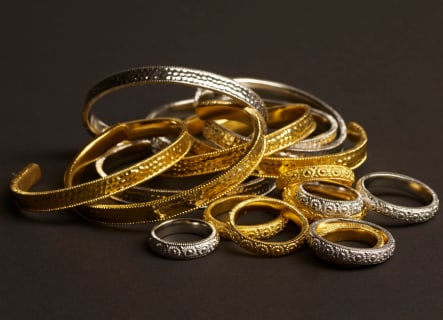
The Menē philosophy: pure precious metal in gold, platinum, and silver.
explore
Gold has a color unlike any other metal. Where silver and platinum reflect a cool, luminous tone, gold carries a deep yellow warmth that has set it apart for as long as it has been worn. The reason for that color is not chemical treatment, surface finishing, or alloying. It is something built into the metal itself, at the level of the atom.
Most metals look silvery for the same reason: their atoms reflect every wavelength of visible light evenly. Silver, platinum, aluminum, and steel all behave this way. When light hits them, what bounces back to the eye is the full visible spectrum, which we read as a cool, mirror-like tone.
Gold does something different. When light hits a gold surface, the atoms absorb part of the blue end of the spectrum and reflect the rest. The light that returns to the eye is therefore missing its blue component, which leaves the warm yellow tones, red and green, dominant in what we see. That is the yellow of pure gold.
The color is not a coating, a treatment, or a result of mixing gold with other metals. It is what gold actually does with light at the atomic level.

The deeper question is why gold atoms behave differently from silver atoms, since the two metals sit next to each other on the periodic table and are structured similarly. The answer comes from the fact that gold atoms are much larger and heavier than silver atoms.
In a gold atom, the electrons orbit the nucleus at extraordinary speeds, fast enough that the laws of physics begin to behave in ways that only apply at speeds approaching the speed of light. At those speeds, the electrons effectively gain mass and pull closer to the nucleus, which changes the energy levels of the atom. The change is small in isolation, but it is the reason gold absorbs the wavelengths of light it does.
In silver, by contrast, the electrons move more slowly. Silver's energy levels are arranged so that the metal absorbs ultraviolet light, which the human eye cannot see. Everything visible bounces back evenly, and silver appears neutral.
In simpler terms, the warmth of gold comes from the fact that its atoms are large enough, and its electrons fast enough, to interact with visible light in a way no other common metal does.
The deep yellow of pure gold is at its most saturated when the metal is in its purest form. At 24 karats, gold contains approximately 99.9 percent gold and almost nothing else. The color is uninterrupted by any other material.
When gold is mixed with other metals to make 18k, 14k, or 10k alloys, the additional metals dilute the color. Copper adds a slight red tone, silver and palladium lighten and cool the yellow, and zinc softens the saturation. The result is a lighter, paler, or more muted version of the original color.
This is why 24k gold reads as the most vivid and recognizable form of gold. It is the color of the metal itself, undiluted by any other material.

Most colors fade. Pigments wear away, dyes lighten, surfaces tarnish or discolor with time. The color of pure gold does none of these things. The yellow is built into the way gold atoms interact with light, it cannot be lost, dulled, or rubbed off. A piece of 24k gold worn for fifty years has the same color it had on the day it was made.
This is also why pure gold does not tarnish. The same atomic stability that gives gold its color also makes it remarkably unreactive. It does not oxidize in air or react with most substances. The metal stays what it is, indefinitely.
This combination of color and stability is part of what has made pure gold the material of choice for the most lasting jewelry across cultures and centuries.
Every Menē piece in gold is crafted in its purest form. There is no plating, no surface treatment, and no alloy diluting the natural color of the metal. The deep yellow of each piece is the deep yellow of gold itself.
Pure gold is yellow because its atoms absorb the blue portion of visible light and reflect the rest. What returns to the eye is the warm yellow tones, which we read as the color of gold. The effect is built into the metal itself, not applied to its surface.
Gold's color comes from the way its electrons interact with light. Gold atoms absorb visible blue light, while most other metals reflect all visible wavelengths evenly and appear silvery. The blue light gold absorbs leaves the yellow tones to dominate what we see.
24k gold is approximately 99.9 percent pure gold, while 18k gold is about 75 percent gold mixed with other metals. Those additional metals dilute the natural yellow, which is why 18k gold reads lighter or cooler than 24k. The lower the karat, the paler the color.
The natural color of gold is a deep, warm yellow. This is the color of gold in its purest form, before any other metals are added or any surface treatments are applied. 24k gold reflects this color most fully.
No. Pure gold does not tarnish, oxidize, or change color. The atomic stability that gives gold its yellow color also keeps it unreactive, so a piece of 24k gold retains the same color decades after it was made.
Yes. 24k gold represents the highest level of gold purity used in jewelry, containing approximately 99.9 percent gold. It is the form of gold that most fully expresses the natural color and stability of the metal.