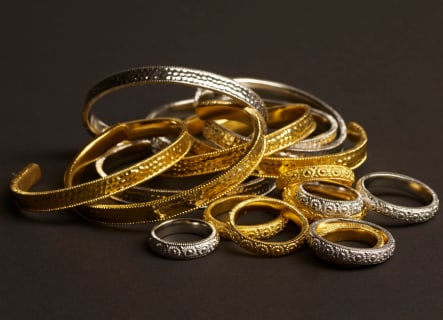
The Menē philosophy: pure precious metal in gold, platinum, and silver.
explore
The word luxury is used widely enough today to mean almost anything. It appears on candles, on bedding, on candles again. It appears on jewelry that is plated rather than solid, on bags that are stitched in volume rather than by hand, on watches that bear the names of celebrities rather than the marks of horologists. The word has lost most of its meaning, which is part of why the question of what actually constitutes luxury is worth asking carefully.
The most enduring answer to that question is craftsmanship. Luxury, at its most honest, is not a marketing position or a price point. It is the result of objects made with care, from materials worth working in, by people whose skill has been developed over years. This piece looks at why craftsmanship is the defining quality of luxury, why it matters more than branding or trend, and how the principle applies to fine jewelry specifically.

Craftsmanship is the practice of making something by hand, with skill developed through experience, using materials that suit the form being made. It carries an implicit set of values: that the maker has trained over years, that the materials are chosen with intention, and that the resulting piece reflects both the form being made and the hand that made it.
True craftsmanship is distinguished from mass production by several qualities. It is unhurried, with each piece given the time it requires rather than the time efficiency demands. It is rooted in tradition, with techniques often handed down across generations of practitioners. It is honest about its materials, with what the piece appears to be and what it actually is held in alignment.
A craftsman is not interchangeable with a worker. The craftsman knows the material as well as the technique, and adjusts both in response to what each piece asks for. The same training that makes a finished piece possible also makes the craftsman able to recognize when something is not quite right and to bring it back to the standard the form requires.
The relationship between craftsmanship and luxury is straightforward but often obscured. An object is luxurious not because of what it costs or what it is called, but because of what it is made of and how it is made. A handbag stitched by machine from synthetic leather is not luxurious, regardless of the name on the label. A handbag stitched by a craftsman from full-grain hide using saddle-stitch techniques is luxurious, regardless of whether the name on the label is recognized.
This distinction matters because the luxury market has spent decades blurring the line between branded goods and genuinely well-made ones. A great deal of what is sold today as luxury is differentiated by marketing rather than by craft. The result has been a flattening of the term, where customers paying for a luxury experience are often paying for branding and packaging rather than for the kind of craftsmanship that the word implies.
True luxury reverses this. The piece is made well first, and what is paid for the piece reflects what was required to make it well. Craftsmanship is not a marketing claim in this model. It is the foundation of the price, the design, and the experience of owning the piece.
Well-crafted goods share a number of qualities that distinguish them from mass-produced alternatives. Recognizing these qualities is part of how a buyer learns to evaluate luxury beyond the marketing.
Materials suited to the form. A well-crafted object uses materials that match what the form requires, not materials chosen for cost or appearance alone. In jewelry, this means precious metals chosen for the longevity of the piece, not alloys designed to look like precious metals.
Construction that reflects the form. The way a piece is put together should reflect what the piece is meant to be. A hand-finished edge, a soldered seam, an engraved surface all reflect choices about how the piece is made that affect how it will hold up over time.
Detail at every scale. A well-crafted piece reads well from a distance and on close inspection. The proportions are considered, the surfaces are uniform, and the small details are as finished as the visible ones.
Honesty about what the piece is. A well-crafted piece does not pretend to be something it is not. The marking, the documentation, and the appearance of the piece all align with the actual material and construction.
Longevity built into the piece. A well-crafted object is made with the expectation that it will last. The construction, the materials, and the design all support continued wear or use across years, often decades, sometimes generations.
Fine jewelry occupies a particular position in the luxury market. Unlike many luxury categories, where the difference between well-crafted and mass-produced pieces is largely aesthetic, jewelry's quality is built into the material itself. A piece of jewelry is, at its foundation, a quantity of precious metal shaped into a form. The metal carries value independent of the design, and the design adds value only insofar as it makes the piece worth wearing.
This means that craftsmanship in jewelry has two distinct dimensions. The first is the material: whether the piece is made from pure precious metal or from an alloy or plated alternative. The second is the work itself: whether the piece has been shaped, finished, and set with the care that fine jewelry requires.
Both dimensions matter, but the first is foundational. A piece made from plated metal cannot be saved by good craftsmanship, because the material itself will fail over time. A piece made from pure precious metal can be poorly crafted, but the material will survive even if the form does not. The strongest pieces combine both: pure material and considered craft.
This is part of what distinguishes fine jewelry from costume or fashion jewelry. The material is the foundation, and the craftsmanship is the elevation. Without the foundation, the elevation has nothing to rest on.

For a buyer evaluating luxury goods, several principles help separate genuine craftsmanship from marketed luxury.
Look at the materials, not the branding. What is the piece actually made of? Is the material identified clearly, with markings or documentation that confirm the content? Pure precious metals, full-grain leathers, and natural fibers are the foundations of luxury craftsmanship. Alloys, synthetics, and plated materials are not, regardless of how the piece is marketed.
Examine the finishing. Well-crafted goods are finished at every visible point, with seams, edges, and surfaces that hold up to close inspection. Mass-produced goods often have rough or uneven finishing at edges and joins, even when the visible surface looks polished.
Consider the documentation. A well-crafted piece is usually accompanied by clear documentation of its materials, its making, and its history. Certificates of authenticity, hallmarks, and provenance documents all support the case for craftsmanship. Pieces sold without documentation, particularly at luxury price points, deserve closer scrutiny.
Think about the piece in five years. A genuinely well-crafted piece should not require replacement or significant restoration within a normal wearing lifetime. If the piece is likely to lose its finish, tarnish, or break down within a few years of normal use, the craftsmanship is not at luxury standard, regardless of what the piece costs.
One of the most useful tests of whether a luxury brand operates on craftsmanship or on branding is how it discusses its prices. Brands that operate on craftsmanship can usually explain what the buyer is paying for: the cost of the materials, the cost of the work, and a reasonable margin. Brands that operate on branding typically obscure these details, with prices set by what the market will bear rather than by what the piece requires to make.
This is part of why pricing transparency has become a quiet marker of craftsmanship in luxury. A brand that publishes the precious metal weight of each piece, the current spot price of the metal, and the margin charged is operating on a different model from a brand that publishes a single price set by a marketing team.
At Menē, every piece is priced according to the gram weight of the pure 24k gold or pure platinum used, the current global market price of the metal, and a transparent Menē Fee that covers the craftsmanship of the piece. The buyer can see exactly what they are paying for, which is the model that craftsmanship has historically supported.
Every Menē piece is crafted in 24k gold or pure platinum, with no plating, no alloy, and no surface treatment between the material and the wearer. The pieces are made by hand, with the same care that has defined fine jewelry across the cultures that have practiced it.
The price of each piece reflects the gram weight of the metal, the current global market price, and the work that went into shaping the piece. The combination of pure material and considered craft is what makes a Menē piece what it is.
Explore the Menē collection in 24k gold and pure platinum and discover pieces shaped from precious metals in their purest form.